Is Now a Good Time to Invest?
One of the most common questions people ask is, “Is now a good time to invest?” Interestingly, this question tends to surface most often when markets are making new highs, and fear of investing at the “wrong time” begins to creep in. We understand you may have heard this from us before, but it bears repeating. History suggests that the answer has less to do with today's headlines and far more to do with maintaining a disciplined, long-term approach.
The Hidden Challenge of Market Timing
Many people assume the current level of the stock market provides insight into where it will go next. Unfortunately, research has consistently shown that future stock returns are unpredictable. As a result, investment decisions based on current market conditions often amount to market timing.
An approach that requires investors to make not one, but two correct decisions:
- When to get out of the market.
- When to get back in.
Getting either decision wrong can significantly impact long-term outcomes.
Missing the Best Moments
One of the greatest risks of attempting to time the market is some of the strongest returns occur during short, unexpected periods. Investors who step away from the market can easily miss these moves.
A useful analogy is attending a sporting event. Imagine leaving your seat because the game seems uneventful, only to miss the most exciting scoring play moments later. To participate in those defining moments, you need to stay in your seat. Investing works much the same way. The biggest gains often arrive without warning, and you can only benefit from them if you remain invested.
Trading One Anxiety for Another
Market downturns can create understandable anxiety. Some people believe moving to cash will reduce their stress while markets are falling. However, when markets inevitably begin to recover, many experience a different form of worry. The fear of missing out on the rebound. In other words, market timing often doesn't eliminate anxiety; it simply exchanges one type of stress for another. You may feel relief during a decline, only to become increasingly uncomfortable watching markets recover while you remain on the sidelines.
What History Tells Us
One of the more compelling observations highlighted in research by Dimensional Fund Advisors is average stock market returns have historically been similar whether you began investing after a new market high or after a market decline of 10% or more. This challenges the common belief you should wait for a pullback before investing.
While market declines do occur and volatility is inevitable, the evidence suggests all-time highs are not reliable indicators of poor future returns. Rather than trying to identify the "perfect" entry point, you have generally been rewarded for remaining invested and allowing the markets to work over time.
The Better Question
Instead of asking, "Is now a good time to invest?" you may benefit from asking:
"Do I have a plan that aligns with my goals, risk tolerance, and time horizon?"
The capital markets offer a positive expected return every day, regardless of whether markets are near highs or experiencing temporary declines. While no one can predict short-term market movements, decades of evidence support the idea that disciplined investors who stay focused on their long-term objectives are often in a stronger position than those attempting to anticipate market swings.
The Bottom Line
A successful investment experience is often less about finding the perfect moment to invest and more about having the discipline to stay invested.
Markets will continue to experience uncertainty, volatility, and periods of decline. Yet the evidence suggests trying to sidestep those periods through market timing is unlikely to improve outcomes consistently. For long-term investors, the most reliable strategy may simply be to remain in their seat, trust the process, and allow time (not timing) to do the heavy lifting.
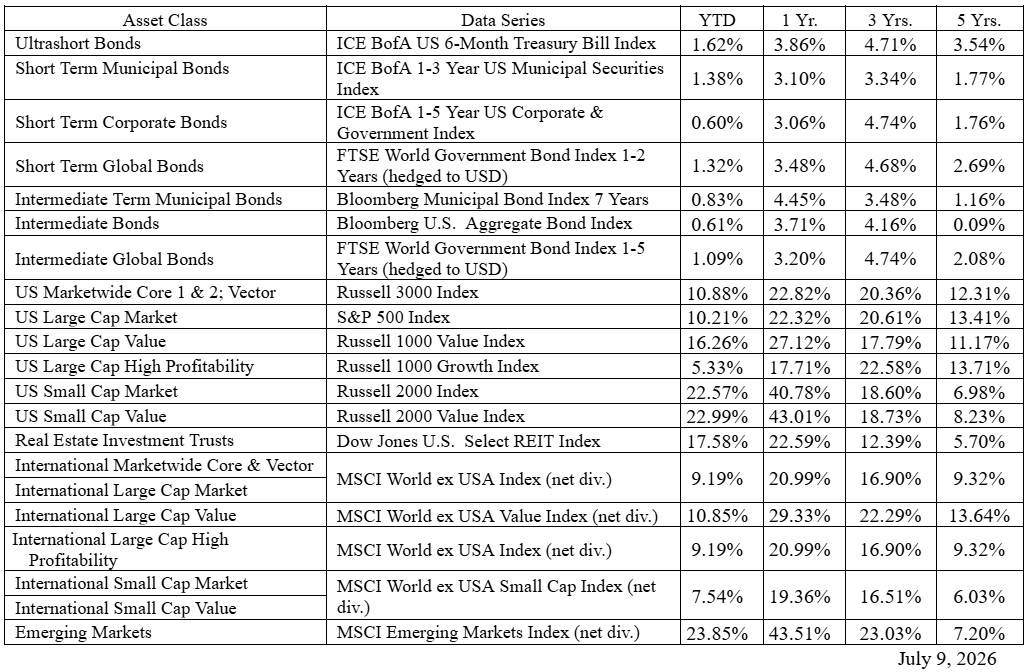
The table below shows the returns through June 30, 2026, for selected investment asset classes. In most cases, the results below are appropriate benchmarks for the related mutual funds in your investment portfolio.